
Deer PFAS Advisories
Consumption Advisory For Deer Near the Town Of Stella
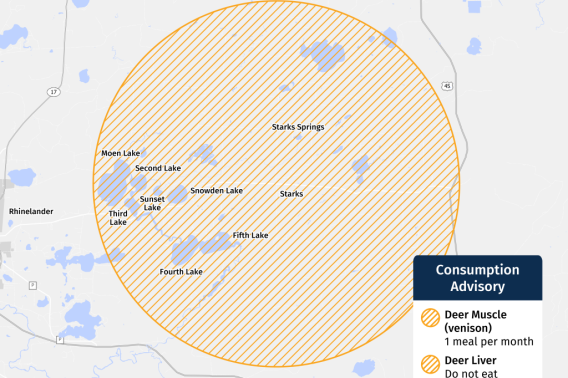
The DNR and Department of Health Services (DHS) have issued new PFAS-based guidance for the consumption of deer harvested within a 5-mile radius of the Town of Stella town hall. The new guidance for consuming harvested deer is one meal per month for muscle tissue and “Do Not Eat” for liver.
For context, the DNR began investigating the PFAS build-up in local deer due to the community’s high interest in PFAS contamination near the town of Stella. To sample deer, the DNR asked hunters within a 3-mile radius to donate muscle and liver samples from their harvests during the 2024 hunting season. A total of 11 deer were sampled, and the DNR and the DHS analyzed the results.
Testing showed elevated PFAS levels in the muscle of (venison) deer harvested from this area. Because of these findings, the DNR and DHS have issued a one-meal-per-month PFAS-based consumption advisory for deer muscle (venison) in a 5-mile radius around the town of Stella.
Sampling results also showed significant PFAS levels in deer liver tissues. The liver filters chemicals from the blood, and chemicals like PFAS can accumulate in the liver over time. These findings suggest that eating liver from deer in this area will likely result in significant PFAS exposure. DHS and DNR recommend not eating liver harvested from deer within the advisory area.
For more information on PFAS, visit the DHS’s PFAS website. The DNR’s Environmental and Health Impacts of PFAS webpage provides information on the effects of PFAS consumption.
Consumption Advisory For Deer Liver Harvested In the Marinette Area
Per- and polyfluoroalkyl substances (PFAS) are artificial chemicals used in industrial processes and manufactured products. They don’t break down easily and can remain in the environment, where people can be exposed to them for a long time.
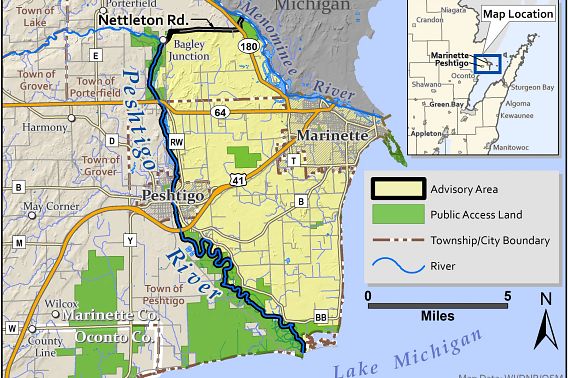
Due to local interest, the Wisconsin Department of Natural Resources studied PFAS levels in deer at the JCI/Tyco Fire Technology Center, 2700 Industrial Parkway, in Marinette. Twenty deer were harvested and measured for PFAS levels in muscle (venison), heart and liver tissues.
For those who eat venison from deer harvested within the five-mile advisory area, the muscle (venison) and heart of white-tailed deer are not likely to result in significant PFAS exposure, according to our findings. Therefore, a PFAS-based consumption advisory is not warranted for the muscles or hearts of deer from this location.
However, our findings [PDF] suggest that eating liver from deer in this area will likely result in significant PFAS exposure. The liver filters chemicals from the blood, and some substances, like PFAS, can accumulate in the liver over time.
DHS and the DNR recommend not eating liver harvested from deer within the advisory area.
PFAS can accumulate in our bodies slowly over time through repeated exposure. High levels of PFAS in the body harm human health, especially that of pregnant women. High levels of PFAS in the body may:
- Increase cholesterol levels;
- Decrease in how well the body responds to vaccines;
- Increase the risk of thyroid disease;
- Decreased fertility in women;
- Increase the risk of high blood pressure or pre-eclampsia in pregnant women; and
- Lower infant birth weights.