|
Images may appear blurry in some web browsers. We recommend opening newsletter links in Google Chrome.

Often, the best way to solve a problem is to look at it from many angles and through a variety of experiences.
That makes Kelsey Taylor ready to take on the set of challenges she’ll face as the new Forest Invasive Plant Coordinator for the Wisconsin Department of Natural Resources – battling buckthorn, scrapping with stiltgrass and going after garlic mustard.
Read the full article here …
|
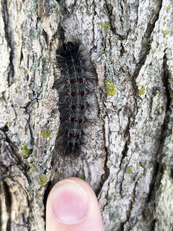
Wisconsin’s recent period of high spongy moth (Lymantria dispar) populations came to an end in 2025 and the population remained very low in 2026.
Only a handful of caterpillar reports were received, most often coming from southern Jefferson County and eastern Dane County. Most notably, numerous bur oaks were reported to be infested with several hundred caterpillars per tree in and around Cambridge, Fort Atkinson and Lake Mills; light feeding damage was visible.
Read the full article here …
|
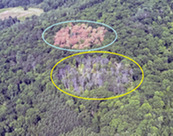
An aerial survey was conducted in late August over parts of Lincoln and Taylor counties, primarily looking for new oak wilt infection centers.
A rare glimpse of what oak wilt control can look like was captured from the vantage point of the airplane. The photo below shows a girdle-herbicide oak wilt control treatment from this year, with trees dying; and another from last year, with dead trees standing.
Read the full article here …
|
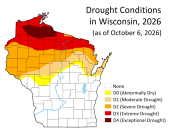
Property owners and land managers in the northern half of Wisconsin are encouraged to monitor forest stands and ornamental trees for signs of decline and mortality due to the intensity of the current drought.
In late September, parts of several counties reached the “Exceptional Drought” condition on the U.S. Drought Monitor, the most severe drought category used and it has only been seen in Wisconsin one other time since 1999.
Read the full article here …
|
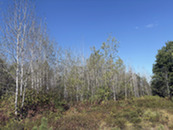
Drought impacts can show up abruptly or have a slower impact, with symptoms becoming visible over the next one to two years.
North central and northwestern Wisconsin have faced significant drought conditions over several months this summer. Some trees have reacted abruptly to these conditions by dropping many of their leaves, and fall color appeared to come early on many stressed trees.
Read the full article here …
|
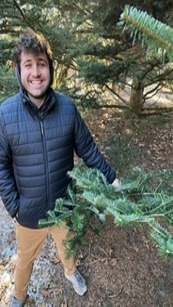
A new interactive opportunity is being offered this fall by the Wisconsin Department of Agriculture, Trade and Consumer Protection to monitor for hemlock woolly adelgid.
Hemlock woolly adelgid (Adelges tsugae Annand) is a tiny, fluid-feeding insect that kills eastern hemlock trees (Tsuga canadensis) within a few years of infestation. Although this non-native forest pest has not yet established in Wisconsin, populations are spreading in neighboring Michigan.
Read the full article here …
|
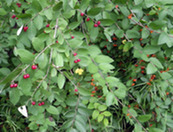
As temperatures begin to decline, the leaves of many plants and trees have begun to change color. Some trees in the northern part of the state have already begun dropping leaves.
The Wisconsin Department of Natural Resources (DNR) reminds the public that in addition to enjoying the changing hues in the woods, fall also presents a great opportunity to spot invasive plants.
Read the full article here …
|
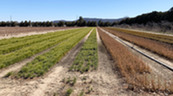
As of Monday, the Wisconsin Department of Natural Resources (DNR) has begun begin accepting seedling orders from Wisconsin landowners who plan to plant them in spring 2027.
The seedling ordering program is switching to a new online storefront. This will give customers using their MyWisconsin ID the ability to select from a live seedling inventory and pay for their orders online at the time of ordering.
Read the full article here …
|
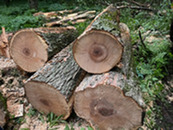
There are some tree diseases that really get a lot of attention and others that get lost in historical documents, only popping up now and again to ignite excitement within the local plant pathologist community.
Maple sapstreak is one of the latter. This year, a site in Shawano County was found to have several trees experiencing symptoms of the disease. The symptoms led to a positive identification of maple sapstreak.
Read the full article here …
|
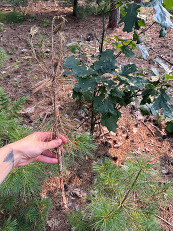
This is a great time of year to be looking for or observing damage from the white pine weevil.
The insect is native and causes terminal leader mortality in susceptible species. Despite the name, there are numerous species of trees that are attacked in addition to white pine, including Norway spruce, jack pine, white spruce and many more.
Read the full article here …
|
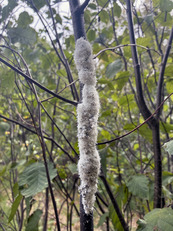
Woolly alder aphids spend their winters on alder stems and summers feeding on maple leaves. Large congregations of these aphids can be visible from a distance, and the bright white patches of aphids may catch your eye.
These plump bluish aphids, with white fluffy growths on their abdomens, are called woolly alder aphids when they’re found on alder – and maple blight aphids during the part of their life cycle when they’re feeding on maples.
Read the full article here …
|
Kyoko Scanlon, Forest Health Lab pathologist for the Wisconsin Department of Natural Resources, gave a presentation at the Upper Midwest Invasive Species Conference (UMISC), which was held Oct. 6-8 at the La Crosse (Wisconsin) Convention Center.
Scanlon updated attendees on a Heterobasidion root disease soil diversity study on Oct. 7.
Read the full article here …
|
Division of Forestry News
Forest Health News
Forest Products News
Private Forestry News
Reforestation News
Urban Forestry News
Wildland Forestry News
|